Fortress or Fallacy? The Real Reason Some Six Nations Grounds Swallow Teams Whole
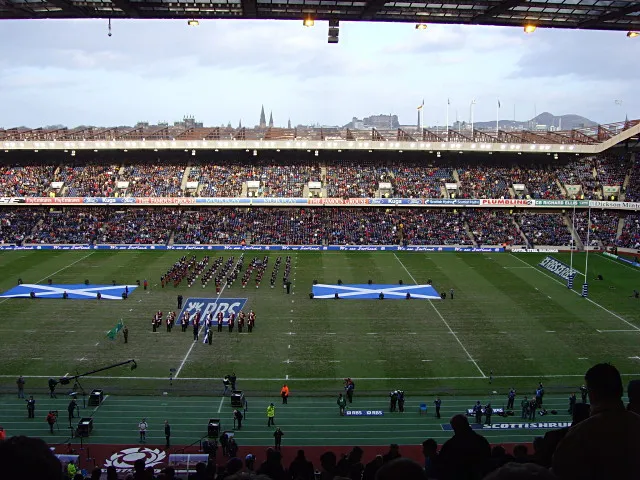
Photo: Paul Chapman, CC BY-SA 2.0, via Wikimedia Commons
Ask any Six Nations player — privately, away from the press conference platitudes — and they'll tell you that certain grounds just feel different. There are stadiums you travel to with a quiet dread that has nothing to do with the quality of the team you're facing. And there are others where, no matter what the form book says, the visiting side somehow always seems to find a way.
Home advantage is one of sport's most discussed and least properly understood phenomena. In the Six Nations, it's particularly fascinating because you've got six countries, six venues, and six completely different environments — each one capable of producing its own distinct psychological and physical effect on the teams walking out of the tunnel.
So why does Murrayfield do what it does to visiting sides? Why has Twickenham, for all its imposing scale, occasionally felt more like a library than a bear pit? And what separates a genuine home fortress from a ground that just happens to have the home team's name above the door?
The Murrayfield Effect: Cold, Loud, and Hostile
Let's start in Edinburgh, because Murrayfield is probably the most compelling case study in Six Nations home advantage. Scotland haven't always been the most consistent side in the tournament — that's just the reality — but their home record, particularly in big matches, has regularly punched above whatever their ranking suggested it should.
The ground itself plays a part. Murrayfield in February is cold in a way that gets into your bones before kick-off, and that affects teams who've travelled from warmer training environments more than it affects the home side who've been preparing there all week. It's not dramatic altitude or anything exotic — it's just reliably, persistently grim in a way that visiting teams from Rome or Paris sometimes visibly struggle with.
But the bigger factor is the noise. Murrayfield has a specific acoustic quality — the way the stands sit, the slope of the terracing, the proximity of the crowd to the pitch — that creates a wall of sound when Scotland are in the ascendancy. Visiting teams have repeatedly described the difficulty of communicating at the breakdown and at lineouts when the crowd gets going. That's not atmospheric flavour. That's a genuine competitive disruption.
Then there's the Flower of Scotland effect. Whatever you think of it as an anthem, the way 67,000 people sing it — with real, unironic fervour — sets an emotional temperature for the match before a single tackle has been made. Visiting players have spoken about the effect it has on them. It's not intimidating in a threatening way; it's just deeply, unexpectedly moving, and it shifts the psychological baseline of the afternoon.
Twickenham: Size Isn't Everything
Twickenham is the biggest ground in the Six Nations. It holds over 82,000 people, which means that on a sold-out match day, it contains more spectators than the entire population of several UK market towns. By any reasonable measure, it should be an imposing, intimidating venue for visiting teams.
And yet. England's home record at Twickenham, across the history of the Six Nations, is decent but not dominant in the way you might expect given the venue's scale. Ireland have won there. Wales have won there. France have produced some of their most memorable performances there.
The reason, if you talk to people who've analysed it carefully, comes down to a few things. First, the crowd at Twickenham can be — and this is said with affection — a bit corporate. There's a significant proportion of the audience who are there for the occasion as much as the rugby, and when England go behind or make errors, the atmosphere can deflate in a way that actually puts more pressure on the home side rather than the visitors. Compare that to Murrayfield or the Aviva, where the crowd tends to stay louder and more energised even when things aren't going well.
Second, Twickenham's sheer size means the noise disperses differently. It's a large, open bowl, and sound doesn't concentrate the way it does in tighter, more compact grounds. Visiting teams report that it's actually more manageable to communicate at Twickenham than at several other Six Nations venues.
The Aviva and the Cardiff Cauldron
Dublin's Aviva Stadium and Cardiff's Principality Stadium both do something that the best home grounds do: they create an atmosphere that feels personal rather than just loud. Ireland's home fans are knowledgeable, vocal, and they stay with the team through difficult passages of play in a way that generates genuine momentum. The Aviva's enclosed design keeps the noise inside the ground rather than letting it float away into the Dublin sky.
Cardiff, meanwhile, has the roof. When the Principality Stadium's retractable roof is closed — which it is for most Six Nations matches — the noise reaches levels that visiting players genuinely describe as disorienting. Line calls become harder. Referee communication becomes harder. The psychological weight of 74,000 people in what is essentially an enclosed space is difficult to overstate. Wales's home record in closed-roof conditions is markedly better than in open conditions, and that's not a coincidence.
Travel, Time Zones, and the Logistics Nobody Talks About
Beyond atmosphere, there are practical factors that are easy to overlook. Travelling to Rome for Italy matches means a flight, hotel adjustment, and a change in food and preparation routine that, while manageable at club level, adds a layer of friction to international preparation. Italy's Stadio Olimpico is not the most intimidating venue in world rugby, but it's far enough away from the other five nations that visiting sides are never quite as settled as they would be for a home match.
France's Stade de France in Paris sits in a similar category — enormous, occasionally electric, but in a city that visiting teams often find distracting in ways that a trip to Edinburgh or Cardiff simply isn't. Paris is Paris. It demands attention.
What Makes a True Fortress
The grounds that genuinely function as fortresses in the Six Nations share a few common traits. They're loud in a concentrated, focused way rather than just a big way. Their crowds stay engaged and emotionally invested even when the home side is under pressure. They have specific physical characteristics — temperature, acoustics, design — that disadvantage visiting teams in subtle but measurable ways. And the home teams have learned to use all of this consciously, building game plans that exploit what their environment offers.
Murrayfield, on its best days, ticks every one of those boxes. Cardiff with the roof closed comes close. The Aviva, in the right fixture, can be extraordinary.
Twickenham has the size. Whether it has the soul to match is a debate English fans have been having quietly among themselves for years.