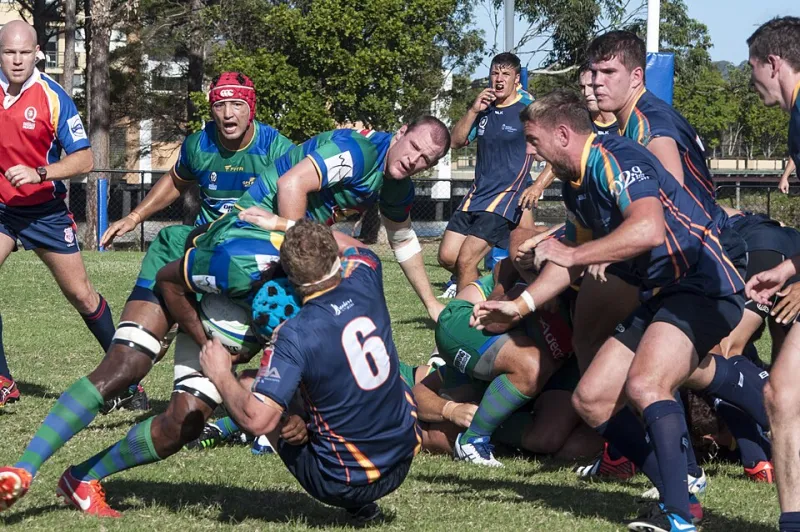
Spreadsheets and Scrums: The Data Revolution Quietly Deciding Six Nations Campaigns

There's a version of rugby that most fans still believe in. Passionate coach, experienced captain, a whiteboard covered in arrows, and a changing room speech that raises the roof. That version still exists — but sitting somewhere down the corridor, probably in a room most players rarely visit, there's a laptop screen glowing with heat maps, load metrics, and probability models that are doing just as much heavy lifting.
The analytics arms race in professional rugby has been building for years. But in the Six Nations — where margins are brutally thin and every fixture carries enormous consequence — the investment in data infrastructure has quietly become one of the most significant competitive battlegrounds in the sport.
What Does a Rugby Data Scientist Actually Do?
It's worth starting here, because the image most people have is either wildly futuristic or deeply underwhelming. The reality sits somewhere in between, and it's more interesting for it.
Modern rugby analytics teams typically work across three broad areas. First, there's opposition analysis — breaking down an opponent's patterns, tendencies, and structural weaknesses using video-tagging software and statistical modelling. Second, there's player performance tracking, which uses GPS-based wearables, accelerometers, and heart rate monitors to build detailed physical profiles. Third, and perhaps most importantly, there's injury prediction — identifying when a player's body is approaching a danger threshold before a breakdown actually happens.
That last one alone is worth an enormous amount. In a tournament where you might only have a fortnight between matches, knowing that a loosehead prop is carrying cumulative fatigue from three consecutive high-intensity games — and adjusting his training load accordingly — could be the difference between having him available for a Grand Slam decider or watching him limp off in the warm-up.
The Nations Leaning In
England and France have been among the most visible investors in this space. England's performance infrastructure under the RFU has incorporated data science roles for several years now, with analysts embedded directly within the coaching environment rather than operating as an external advisory function. The distinction matters — when data is baked into the daily rhythm of the coaching week, it influences decisions in real time rather than arriving as a PowerPoint presentation on a Thursday.
France's transformation under Fabien Galthié has been widely attributed to tactical clarity and player development, and those things are genuinely true. But less discussed is the analytical infrastructure that underpins their squad management, particularly around load monitoring for a generation of young players being asked to perform at the highest level week after week.
Ireland, meanwhile, have built something arguably more sophisticated than either — a culture where data literacy among coaches and senior players is treated as a core competency rather than a novelty. The detail in their lineout execution, their defensive line-speed consistency, and their ability to exploit specific structural vulnerabilities in opponents all bear the fingerprints of serious analytical investment.
The Traditionalist Pushback
Not everyone is convinced, and it would be dishonest to pretend the sceptics are simply behind the times.
Some coaches — particularly those who built careers in an era when instinct and experience were the primary currencies — remain wary of over-relying on models that reduce complex human performance to numbers. Rugby, they'll tell you, is played by people, not algorithms. A player who looks statistically spent on a Thursday might still produce the defining carry of a championship on a Saturday because of something no sensor can measure: desire, leadership, the weight of a jersey.
There's also a legitimate concern about analysis paralysis. Feed a coaching team too much data without the right framework to interpret it, and you don't get clarity — you get noise. The teams getting the most from their analytics investment tend to be the ones who've figured out how to translate data insights into simple, actionable decisions rather than drowning in dashboards.
Real-Time Biometrics: The Matchday Frontier
If pre-match analytics represents the planning phase, real-time biometric monitoring is where things get genuinely frontier-level. Several Six Nations squads are now using live data feeds during matches — not just for injury monitoring but for performance state assessment.
Imagine a scenario: your number eight is showing elevated fatigue markers at the fifty-minute mark, his sprint recovery times have dipped below a threshold your analysts flagged in pre-tournament modelling, and the opposition are about to launch a sustained phase-play attack. Your data team flags it. The coach makes the call to bring on the replacement not at sixty-five minutes as planned, but now. That's not hypothetical — variations of exactly that scenario are playing out in top-level rugby regularly.
The regulations around what can be communicated to coaches during live play are still evolving, and there's a broader conversation to be had about where the line sits between legitimate performance support and something that starts to compromise the organic nature of the game. But for now, the technology is moving faster than the rulebook.
The Nations at Risk of Falling Behind
Here's the uncomfortable part of this conversation. The investment required to build genuine analytical capability — the software licences, the specialist staff, the wearable technology, the data integration pipelines — is not trivial. For the larger unions with significant broadcast revenue and commercial partnerships, it's manageable. For others, the budget conversation is considerably harder.
Scotland and Italy, in particular, face structural resource constraints that make it difficult to match the analytical infrastructure of their bigger rivals. That doesn't mean they're operating blind — both unions have made genuine efforts to modernise their performance environments — but the gap in analytical depth between the top and bottom of the Six Nations table is real, and it's not entirely explained by playing talent.
Wales, currently navigating a difficult period both on and off the pitch, have faced questions about whether their performance infrastructure has kept pace with the demands of the modern game. When results are poor, the scrutiny tends to land on the coaches and players. But sometimes the answer lies further upstream, in the systems and resources that support them.
What This Means for the Fans
For supporters watching on a Saturday afternoon, most of this is invisible. You see the lineout going wrong, the defensive drift leaving a gap, the kicker making or missing under pressure. You don't see the hours of modelling that informed the call-sheet, or the load data that determined whether a key player started or was held back for the final quarter.
But understanding that this layer exists — and that it's increasingly decisive — changes how you read the sport. The Six Nations isn't just a physical and psychological contest anymore. It's an information war, fought in spreadsheets as much as scrums.
And the teams winning that war aren't necessarily the ones with the most talent. They're the ones who've figured out how to use everything they know — about their players, their opponents, and the game itself — in the most intelligent way possible.
In a tournament where a single converted try can separate champions from also-rans, that's not a small advantage. It might be the biggest edge in the game.